Showing posts with label experience. Show all posts

Tuesday, July 23, 2013

What Can We Do? A Meditation on Action

Life changes. That's a fact we all know but people seldom think about. Every day is unique but in our fast moving world, we have created the illusion that there's such a thing as a "normal" week that includes a period of rest we call the "weekend".


The more I grow in my practice of various forms of meditation, the more I realise how easy it is to go through life following habit and routine without stopping and reflect on the point of it all. For, while life may seem to be going great, we night fail to appreciate the moments in which we find our peace and comfort. It's only when we realise we lost something that we start to appreciate its value.


We also risk believing that we have more control over our world than we really do. As life goes through its natural cycle of birth, death  and renewal, we change as well. I have gone through particularly hard times in my life recently and I can't say that I found my peace.


Indeed, while we may have an idea that mindfulness and meditation provides us with peaceful bliss, its proper practice also exposes us to the scars which were deeply hidden in our mind. Yet, unpleasant as they are, acknowledging their presence can help us to slowly detach ourselves from them.


Even if I am trying to give up my attachment to the world, I confess it's harder than I thought. I still remain attached to my pride and sometimes still crave to acquire a particular thing or position. But then again, I know how . foolish my thinking is. Yet, I can still be a fool. Acknowledging that is the first step - even if my pride gets angry.


The fact is that there's very little we can change in the world. There are so many factors that are permitting that we have the right conditions to keep alive that it would be impossible to list them and some I don't even know about. We also depend on the living world, including the people we live with on this rotating piece of rock. 


So what can we do? While we may not be able to change the world or even "save" it, there's only one thing I learned that you may find of value. You can only change yourself. Yet, until you take the time to get to know who you are, each day will remain as insignificant as the one before. 


Don't expect to change overnight and don't even expect it to be painless. You may even find you're failing, like I feel lately, but you should keep in mind that the real peace, freedomm and happiness we all seek is not to be found in the world but in you and in how far you're ready to recognise your littleness in the  context of the whole.

Sunday, July 21, 2013

A Meditation on Forgetting


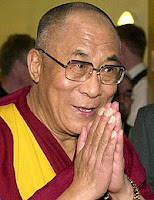
HH Dalai Lama celebrated his 78th birthday  last Saturday, 6th July… and I forgot!


A Confession

I must confess that I have forgotten  to write an entry on the occasion of HH Dalai Lama which I started doing when I started this site. I have already written extensively about how indebted I am to HH 14th Dalai Lama for opening my mind to a fresh understanding of life and reality. I find that I feel a bit angry and rather ashamed of having forgotten the man who helped e to embark on the journey where I can better understand who I am and my place in this world.


In a way, this journey of self-discovery which I have been writing about since 2011 began as a child. But then, my curiosity to know about HH Dalai Lama and to understand Buddhism didn’t take me far. Even my brief exploration of world religions that I carried out as I was writing my book Cosmos also didn’t help me that much as I only read sources which tended to hold that Buddhism was a nihilistic tradition.
I find that the past remains an important part of who we are. It’s true that it’s not good to dwell on the past but it would be wrong that we completely forget it. For the past, whether we like it or not, has affected and affects who we are today.


Yes, I forgot that on the 6th JUly of 1935, a young boy called Tenzin Gyatso would be declared to be the re-incarnation of his predecessor Thubten Gyatso. Much has been written, of course, on the Dalai Lama’s early days but I feel That I have been affected but the way he speaks and expresses his thoughts with a rare sincerity and with a genuine interest in the welfare of all humankind and all sentient beings. Yet, as he admits himself, he is just a man like any other and he doesn’t want people to regard him as a god-figure. In particular, there are three things that have struck me as he talks about Buddhism. Precepts that, you might have noticed, I constantly refer to when writing here and which I use as guides in other writing that is not related to Buddhism as such.


My Guiding Principles

These principles, simply put are:

Dependent arising. The teaching that who we are is the product of countless causes and conditions that have made our life possible.


co-dependence e. The reality that who we are and what we have depends on other factors that are beyond our control. These range from the physical world - material objects, nature, living things and weather conditions; to the relations we have with other people.


Impermanence. The fact that nothing lasts forever. Everything in the universe is changing, including the universe itself. And, all all of this will one time end.

The Impermanence of Forgetting


In this sense, we can see forgetting as the manifestation of the impermanence of memory. Yet, we may forget other things in life that are as important as memory is to remember who we are. I feel that, due to strong emotions, that arose from a dark place within. As a result, I started forgetting what was important in my life. I was forgetting the values I believed in. Perhaps I was under the illusion that I was better than others or that I had a rightful claim to be arrogant because I felt that I was in the right and that all I said can't and shouldn't be contradicted because it was absolute - when, in fact, right as it may have been, it was relative. Yes, I may have been in the right at times but my approach was also wrong.

It is often the case that because we feel we have found our truth, we forget that we remain always subjective in our judgments and fail to consider how our words and actions might affect other people.

I am not saying that we do wrong if we make our point or feel that we must take action. Yet, even if we are right and correct, the way we assert our convictions can easily undermine their importance. It’s a choice whether to pursue the path of violence or the path of non-violence. The former may appear to be stronger and the more effective. Yet, while the path of violence may get more immediate results, it only reacts to the effect of the real cause of our affliction and may also obscure the real causes of the affliction.


Healing the Past: To Forgive, Not Forget…

I am sorry that I forgot to remember that on July 6, 1935, Tenzin Gyatso was born. But, I feel greater sorrow that while my writing has been largely unaffected by past afflictions, I cano’t say the same about some words and actions that I have carried out in an attempt to reclaim what I felt was unfairly taken away from me.


But, in doing so, I became a slave to this past and never really freed myself.

The only way we have to heal the past is to forgive all the injustice perpetrated against us as we can’t change the past. Yet, while we should not forget our past as it has shaped who we are, we should strive to forgiveness ensures that we don’t remain slaves to our past and be willing to be more open to trusting others guided by the wisdom of our past injustices.


We should strive to cultivate our compassion as it is the only guarantee of our own happiness and that of others.
In HH the 14th Dalai Lama’s own words:


“If you want to be happy… practice compassion…


If you want others to be happy… practice compassion…”


I wish belated wishes to HH Dalai Lama.


Thank you very very much!


Older Entries

2011: Celebrating HH the 14th Dalai Lama's 76th Birthday
2012: Tomorrow ... It's the 6th July? So, It's HH 14th Dalai Lama's 77th birthday!!!

Thursday, July 18, 2013

ZoneMind: A Day of Shame - Identity, Indifference & Humanity (Full Series)

Part 1: Hollow Identities?

> ORIGINAL SOURCE


This July was a time I felt that I had to re-evaluate who I was and to reflect on my position on this Earth and wonder once again on where I belonged. I decided to leave FaceBookas I was growing concerned that, in spite of all the good things it offered me, I found myself too dependent on it and sometimes felt I had to project an identity that pleased the public which I felt more and more to be somewhat oppressive, encouraging a culture of impulsive reactions which didn’t promote finding time for reflection or cultivate personal growth. I felt that sometimes I had to hold back too much parts of who I was and perhaps the reason I finally left was to be found in my past.


Yes, there was another reason I decided to leave. Perhaps I realised that being on FaceBook was my way of validating who I was because I still felt like an outsider. I still felt without acknowledging it, that I wanted to be accepted and taken for who I was or what I believed in. But, then, I always ran the risk of posting something for the sake of it. I might have felt that the media had once robbed me of my right to claim an identity as an individual when I was still a child. And, yes, while I thought I got over it, the scars in my mind were still there and still bleeding.

Indeed, I found that the painful memories I had when I was still a disabled boy were still there hidden in my mind. I realised that these ‘demons’ of the past which I thought I conquered were still acting in the background. I cannot say that this was a positive experience. It was not. I made that clear in my entry and recording found on a recent post entitled “Is Virtue Its Own Reward”. For, even if it was a difficult time in my childhood, I admit that it also taught me about myself and about how society viewed me.

Many times, we often judge things in terms of good or bad.

However, life is more of an experience that is in-between.

And there are many experiences in my life which may be judged as bad or terrible. The fact is that while our experiences may be a source of pain and anger, sometimes they are inevitable and necessary to learn and grow up. When I could still walk, I remember that there were many times I fell from my bicycle when I was first learning how to ride a bike. But, eventually, I had mastered the skill of riding a bike. Yes, I know that today I won’t be able to write a regular bike at least but I did benefit from learning that skill the time I could do it.

In the same way, the pain I felt as a disabled child when I realised that to the world I was just a one-dimensional boy ‘afflicted’ by impairment and a ‘burden’ and ‘sacrifice’ to society and to my best friend was when I lost my balance on the ‘bicycle’ of life and face the fact that no matter who I was or what I did, I will also risk being judge by my impairments.

From that day on, I felt I could relate to the countless times I found myself ill-at-ease when I listened to so-called grown ups making fun of people who were different than them, whether they were of a different faith, whether they were black, whether they were women or whether they were gay.

Unfortunately, I do confess that at times I did join in to make some witty remark but, I found that I preferred to remain silent when the words I heard felt wrong and unkind. But my silence was not that better. I didn’t know I had a choice. However, the experiences I had when I realised that for society I was to be an outsider with people arrogantly thinking that they can tell my story and distort my life to the extent it sounded more like melodrama.

I just wasn’t that boy they had constructed out of their assumptions and misconceptions.


It was from then on that I must have started realising I was an outsider. Society wasn’t interested in who I really was, it preferred to create n image for the sake of increasing sales and popularity. I was like a Joseph Merrick whose physical differences were the main reason he drew the interest of the people of his time.


Part 2: an Indifferent Ignorance

 > ORIGINAL SOURCE  


I felt that I could relate to my earlier discomfort when I heard people saying things about individuals they never met or didn’t intend to mix with. As I read about the struggle of black Americans in the US for civil rights, I felt that Martin Luther King Junior was also talking about an experience not dissimilar to my own.

As I read about Gandhi’s protests against the British colonisers, I felt that, in some way, I was colonised by a non-disabled ideology that placed people like me who had an impairment amongst the lowest classes of society, sustaining the belief that impairment was an inevitable reality and that I must accept my burden and not expect to be an equal. Of course, it would be much later in my 20s that I would be introduced to the idea of the social model of disability that appeared to given me a voice and the words to articulate my experiences.

For, like racism, sexism, homophobia or any other forms of intolerance that existed about people who may be different than us, The fact I had an impairment wasn’t the problem in itself. 

Indeed, one major problem was the attitude people had about impairment which was often seen to define my whole identity - even erasing any other aspects of my humanity.

However, unlike other forms of discrimination, society has also proved to reject my body whenever I was denied access to places or to resources simply because my body didn’t conform to the imaginary ‘norm’. Despite this fact, attitude played an important role on my feeling of being an outsider.

Like the black men and women in 50s America, I didn’t have equal rights in so many areas. Like the colonised Indian, what I owned and my history was always inferior to that of the unreal norm. Like the

African, to the West, I had no history and my impairment remained a curse or the effect of nature gone wrong.  Thus, my mind

and body appeared to be a defiance to the Graeco-Roman ideals of perfection. The only means that we all have to relate with the world suddenly seemed to have been imbued with features and characteristics that were never there but were only created by our limiting minds. 


This is why I felt I was an outsider as a boy. This is why I feel like an outsider sometimes even  today. 

I felt the need to speak about the injustices that I witnessed this week in an episode entitled Lives Should Never Be Used As Meanswhich I posted on my podcast channel . The inhumanity in the government’s attempt to deport a group of Somali migrants back to Libya. While Malta has limited resources to provide shelter to more migrants, I felt that this attempt at sending a message to the EU that Malta needed more support was morally deplorable on so many levels. For, given that Libya remains unstable and that the detention centres at Libya offer very poor human conditions while guards there don’t seem to have any respect for human rights,, 

if our government hadn’t been stopped, these immigrants would have certainly suffered torture, rape and death. And I don’t like to call them ‘immigrants’ but language is often constraining. They are, first and foremost, people - men, women and children. They are my brothers and sisters. They all have their own identities, likes and dislikes. They feel the same feelings and emotions that I feel. Like them, I can get sick and I will die. We share the world with each other.

Part 3: Humanity Denied!

> ORIGINAL  SOURCE


Before starting this last entry, I wish to share a few verses inspired from  the words that are attributed toMartin Niemöller as I can see the danger in arguments and action that seem to imply that our human rights can be negotiated or, worse, put to the majority vote. I am painfully aware that, as a disabled person, many (if not all) of the rights I and other disabled people, would have prevailed and it's only because of some pioneers that made sure our rights should be legally recognised that we can say that we have more opportunities today - even if there's more to be done to gain real equality for disabled people. But I digress, so here are the adapted version of  Martin Niemöller's speech foe our local reality as I am currently perceiving it:: 

Now, they were coming for the migrants,


And we said nothing...


Then they came for those who were Muslims...

And we said nothing.


Then they robbed once who identified themselves as LGBT of their rights...

And we said nothing...


Then they attacked the environmentalists...

And as nature was dying...


Our mouths were still shut...


They would also make ones protecting human rights of minorities and other discriminated social groups appear to be unpatriotic...


And we still said nothing.


Then, when they came after us...


Well, no one was  there to defend us!


I don’t want to sound too pessimistic but unless we don't speak together against injustice perpetrated on others, we have lost our claim to our own rights. Unless we come together and really together on issues concerning human rights, then all expressions of solidarity and talks social inclusion remain simply empty rhetoric. When people in my own country forget their humanity, these people seeking refuge become a group of people robbed of an identity. At the same time, we choose to impose our own prejudice and assumptions on them turning them to monsters and even savages. When we look at them, there is a danger that we project our own fears onto them.Perhaps we fear of losing our own identity. Rejecting them would mean that we cling to the delusion that we’re far better than them or more ‘civilised’ than them. We might have believed that they were poor people suffering from famine and starvation. We might still have an image of those children with swollen stomachs. We might have pitied them. We might have thought of Africans as savages without a history or tradition. Like the Africans of that distorted Africa found in, for example, Conrad’s Heart of Darkness.


In many ways, I feel that I must speak up against any attempt to reduce the rights of these people we call immigrants. I feel that I am also an outsider. In spite of any nice things said about disabled people, there are still many who harbour deep inside a certain resentment and fear of becoming like us - which is likely to happen as they age. I am, like the immigrant, an outsider - the other. And being the ‘other’ makes me a threat to the social order. For, in fully accepting me and people who are different, society would have to face the reality that we are more like each other than we are different. And while our differences matter, they are not fundamental to who we are. The day when we even considered sending people back to most certain torture, humiliation and death can’t be ever justified.

It was a day of shame for us and for Malta when we were close to to remain indifferent to our fellow human beings for the sake of making a political point.


While we may come to be forgiven for these actions, I believe we must make sure that we don’t forget. Even if the public has a short memory and the media is always looking for the next controversy, we can’t afford to forget. For forgetting would mean that next time we may actually have blood on our hands.

To end this long entry, I wish to express my last thoughts in the Japanese haiku form:

Yes, we must forgive...


But I refuse to forget...


This moment of shame.

End of series!


ABOUT THIS ENTRY

 This series originally appeared as a three-part series of entries published on my blogZoneMind between July 12 and July 14., 2013. This version has been slightly edited. If you enjoyed this entry, you can follow some of my activity on Twitter@gordonGT. 

> Feel free to share this post but kindly attribute this source;.

Sunday, July 14, 2013

A Day of Shame: Identity, Indifference and Humanity - Part 3

PART 1 - PART 2 - PART 3


Part 3: Humanity Denied!


Before starting this last entry, I wish to share a few verses inspired from the words that are attributed to Martin Niemöller as I can see the danger in arguments and action that seem to imply that our human rights can be negotiated or, worse, put to the majority vote. I am painfully aware that, as a disabled person, many (if not all) of the rights I and other disabled people, would have prevailed and it's only because of some pioneers that made sure our rights should be legally recognised that we can say that we have more opportunities today - even if there's more to be done to gain real equality for disabled people. But I digress, so here are the adapted version of Martin Niemöller's speech foe our local reality as I am currently perceiving it::


Now, they were coming for the migrants,

And we said nothing...


Then they came for those who were Muslims...
And we said nothing.

Then they robbed once who identified themselves as LGBT of their rights...
And we said nothing...

Then they attacked the environmentalists...
And as nature was dying...
Our mouths were still shut...
They would also make ones protecting human rights of minorities and other discriminated groups appear to be unpatriotic...
And we still said nothing.
Then, when they came after us...
No one was  there to defend us!


I don’t want to sound too pessimistic but unless we don't speak together against injustice perpetrated on others, we have lost our claim to our own rights. Unless we come together and really together on issues concerning human rights, then all expressions of solidarity and talks social inclusion remain simply empty rhetoric.

When people in my own country forget their humanity, these people seeking refuge become a group of people robbed of an identity. At the same time, we choose to impose our own prejudice and assumptions on them turning them to monsters and even savages. When we look at them, there is a danger that we project our own fears onto them.

Perhaps we fear of losing our own identity. Rejecting them would mean that we cling to the delusion that we’re far better than them or more ‘civilised’ than them. We might have believed that they were poor people suffering from famine and starvation. We might still have an image of those children with swollen stomachs. We might have pitied them. We might have thought of Africans as savages without a history or tradition. Like the Africans of that distorted Africa found in Conrad’s Heart of Darkness.

In many ways, I feel that I must speak up against any attempt to reduce the rights of these people we call immigrants. I feel that I am also an outsider. In spite of any nice things said about disabled people, there are still many who harbour deep inside a certain resentment and fear of becoming like us - which is likely to happen as they age. I am, like the immigrant, an outsider - the other. And being the ‘other’ makes me a threat to the social order. For, in fully accepting me and people who are different, society would have to face the reality that we are more like each other than we are different. And while our differences matter, they are not fundamental to who we are. The day when we even considered sending people back to most certain torture, humiliation and death can’t be ever justified.

It was a day of shame for us and for Malta when we were close to to remain indifferent to our fellow human beings for the sake of making a political point.

While we may come to be forgiven for these actions, I believe we must make sure that we don’t forget. Even if the public has a short memory and the media is always looking for the next controversy, we can’t afford to forget. For forgetting would mean that next time we may actually have blood on our hands.

My last thoughts in haiku:


Yes, we must forgive...
But I refuse to forget...
This moment of shame.


End of series!


READ THE WHOLE SERIES:
PART 1 - PART 2 - PART 3

Saturday, July 13, 2013

A Day of Shame: Identity, Indifference and Humanity - Part 2

PART 1 - PART 2 - PART 3 1 - PART 2 - PART 

Part 2: an Indifferent Ignorance 

I felt that I could relate to my earlier discomfort when I heard people saying things about individuals they never met or didn’t intend to mix with. As I read about the struggle of black Americans in the US for civil rights, I felt that Martin Luther King Junior was also talking about an experience not dissimilar to my own.


As I read about Gandhi’s protests against the British colonisers, I felt that, in some way, I was colonised by a non-disabled ideology that placed people like me who had an impairment amongst the lowest classes of society, sustaining the belief that impairment was an inevitable reality and that I must accept my burden and not expect to be an equal. Of course, it would be much later in my 20s that I would be introduced to the idea of the social model of disability that appeared to given me a voice and the words to articulate my experiences.

For, like racism, sexism, homophobia or any other forms of intolerance that existed about people who may be different than us, The fact I had an impairment wasn’t the problem in itself. Indeed, one major problem was the attitude people had about impairment which was often seen to define my whole identity - even erasing any other aspects of my humanity. However, unlike other forms of discrimination, society has also proved to reject my body whenever I was denied access to places or to resources simply because my body didn’t conform to the imaginary ‘norm’. Despite this fact, attitude played an important role on my feeling of being an outsider. Like the black men and women in 50s America, I didn’t have equal rights in so many areas. Like the colonised Indian, what I owned and my history was always inferior to that of the unreal norm. I was and still feel an outsider.

This is why I felt the need to speak about the injustices that I witnessed this week in an episode entitled Lives Should Never Be Used As Means which I posted on my podcast channel . The inhumanity in the government’s attempt to deport a group of Somali migrants back to Libya. While Malta has limited resources to provide shelter to more migrants, I felt that this attempt at sending a message to the EU that Malta needed more support was morally deplorable on so many levels. For, given that Libya remains unstable and that the detention centres at Libya offer very poor human conditions while guards there don’t seem to have any respect for human rights,, if our government hadn’t been stopped, these immigrants would have certainly suffered torture, rape and death. And I don’t like to call them ‘immigrants’ but language is often constraining. They are, first and foremost, people - men, women and children. They are my brothers and sisters. They all have their own identities, likes and dislikes. They feel the same feelings and emotions that I feel. Like them, I can get sick and I will die. We share the world with each other.

CONTINUED…

PART 1 - PART 2 - PART 3

Friday, July 12, 2013

A Day of Shame: Identity, Indifference and Humanity - Part 1

Part 1: Hollow Identities?

This July was a time I felt that I had to re-evaluate who I was and to reflect on my position on this Earth and wonder once again on where I belonged. I decided to leave FaceBook as I was growing concerned that, in spite of all the good things it offered me, I found myself too dependent on it and sometimes felt I had to project an identity that pleased the public which I felt more and more to be somewhat oppressive, encouraging a culture of impulsive reactions which didn’t promote finding time for reflection or cultivate personal growth. I felt that sometimes I had to hold back too much parts of who I was and perhaps the reason I finally left was to be found in my past.

Yes, there was another reason I decided to leave. Perhaps I realised that being on FaceBook was my way of validating who I was because I still felt like an outsider. I still felt without acknowledging it, that I wanted to be accepted and taken for who I was or what I believed in. But, then, I always ran the risk of posting something for the sake of it. I might have felt that the media had once robbed me of my right to claim an identity as an individual when I was still a child. And, yes, while I thought I got over it, the scars in my mind were still there and still bleeding.


Indeed, I found that the painful memories I had when I was still a disabled boy were still there hidden in my mind. I realised that these ‘demons’ of the past which I thought I conquered were still acting in the background. I cannot say that this was a positive experience. It was not. I made that clear in my entry and recording found on a recent post entitled “Is Virtue Its Own Reward”. For, even if it was a difficult time in my childhood, I admit that it also taught me about myself and about how society viewed me.

Many times, we often judge things in terms of good or bad.

However, life is more of an experience that is in-between. And there are many experiences in my life which may be judged as bad or terrible. The fact is that while our experiences may be a source of pain and anger, sometimes they are inevitable and necessary to learn and grow up. When I could still walk, I remember that there were many times I fell from my bicycle when I was first learning how to ride a bike. But, eventually, I had mastered the skill of riding a bike. Yes, I know that today I won’t be able to write a regular bike at least but I did benefit from learning that skill the time I could do it.

In the same way, the pain I felt as a disabled child when I realised that to the world I was just a one-dimensional boy ‘afflicted’ by impairment and a ‘burden’ and ‘sacrifice’ to society and to my best friend was when I lost my balance on the ‘bicycle’ of life and face the fact that no matter who I was or what I did, I will also risk being judge by my impairments.

From that day on, I felt I could relate to the countless times I found myself ill-at-ease when I listened to so-called grown ups making fun of people who were different than them, whether they were of a different faith, whether they were black, whether they were women or whether they were gay.

Unfortunately, I do confess that at times I did join in to make some witty remark but, at times, I remained silent. But my silence was not that better. I didn’t know I had a choice. However, the experiences I had when I realised that for society I was to be an outsider with people arrogantly thinking that they can tell my story and distort my life to the extent it sounded more like melodrama.

I just wasn’t that boy they had constructed out of their assumptions and misconceptions.

It was from then on that I must have started realising I was an outsider. Society wasn’t interested in who I really was, it preferred to create an image for the sake of increasing sales and popularity. I was like a Joseph Merrick whose physical differences were the only reason he drew the interest of the people of his time.

CONTINUED…

PART 1 - PART 2 - PART 3

Sunday, June 16, 2013

On Father...

Today, in this part of the world, we celebrate Father’s Day. I wanted to share some reflections on this day. I admit that I believe it’s rather artificial to pretend that this particular day is set apart for fathers. The same can be said of other days similar to this, such as mother’s day or children’s day. The fact that while this day offers me an opportunity to think about how my father has supported me during my life, the fact is that my father was always there. And, thankfully, in spite of being in his early 80s, he is healthier than I am and far stronger than I can ever be.

I can say that my father remains an important person in my life. I have fond memories when I was younger and used to take walks out with my father and discussed a wide range of subjects, my hopes and fears and so on. He also encouraged me to think for myself and not to let others decide on my behalf. He also encouraged me to pursue my constant and, yes, tiring questioning… Why? How? When? Etc. Now, that I think of it, he was a great influence in my life and, most importantly, he gave me the freedom to ask question and think on my own.

Of course, there were many occasions when I rebelled and felt I ‘hated him’ for denying me what I wanted. I really don’t know what came on me when I hit puberty. But, today, I am happy that my dad is still alive and part of my life. We don’t always share the same opinions on certain topics but we share a lot, I believe, in our value system. I cannot speak of experiences where fathers have been absent or, worse, violent towards their partners and children - I can only speak of my own experience. And, yet, I have had other father figures in my life who have helped me in developing my thoughts and identity. To all those who have been a surrogate father, for lack of a better word - I thank you too.

I hope that my father will remain with me in this life for some more years to come. I will surely miss him if he is gone. Yet, I hope to remember him in my heart and in the memories I have of the time we have and are spending together.

You helped make me the man I am today!

Sunday, April 7, 2013

A Secular Easter, An Empty Tomb and a Dead God: A Long Easter Meditation

What to write?

 
I have been struggling to gather my thoughts and ideas before daring to write this entry. I had planned to have something ready on Easter Sunday which would made this entry topical and current. Today, a week has already passed since Easter Sunday and believers and non-believers have probably forgotten the festivities and returned back to their old routines when they went back to their regular routines. A thing  I usually did myself in the past.
 
I admit that my hesitation to tackle the subject of Easter may be due to the fact that I don’t see myself as a Roman Catholic. I cannot hide the fact that, even if as a child, I always felt not quite comfortable with aspects of Catholicism because, as I liked to learn on my own, the majority of Christians had only a superficial understanding of their faith. As a child, I was prone to reason out some of the teachings as interpreted by the priests of my time. I knew deep inside that a morality based on fear of hell was a very shallow one. But, that possibility of being punished by God was too terrible to contemplate. Naturally, heaven was where I wanted to be after I died.
 
I was both shocked and disturbed when I started reading parts of the Old Testament your average Christian wouldn’t have read in their life time. For instance, Leviticus, which, to my horror, forbade anyone who had an impairment of any sort to offer anything to God for that person was unworthy to be in God’s sight. And, references to impairment as sin in the New Testament started making sense. Indeed, Jesus tried to address the irrationality of such beliefs. But, I can attest that I did feel awkward among the fervently religious. At times to be called saintly, and in the silence of the hearts, some suspected I was the result of sin. Images of the devil have also suggested impairment of some sort to me. While I denied my impairment for many years. 
 
Yet, deep down, I knew that the logical conclusion of what Leviticus had been saying was that I was unworthy of God. In that sense, I had some sympathy with the devil when he was expelled from heaven. Not that I wanted, in any way, to become God. But, rather, because I could identify of being rejected and excluded because I was physically different. Yes, the devil’s sin was that of pride but he was always represented as the ‘other’. I could relate to that feeling of otherness and rejection. Indeed, as I rekindled my passion for Eastern philosophy and Buddhism, in particular, it was I found an old childhood friend. I once again started meditating but this time wanted to further cultivate my understanding of Buddhist thought. 
 
I don’t see myself as a Roman Catholic any more but I am grateful for the teachings I got from Christianity. In a sense, I am practicing a philosophy beyond the confines of religion. I have no problem with the belief in God and also find no problem with those who don’t believe in God. However, I’m saddened when supposedly mature adults debate on whether God exists or not as their lives depended on it.
 
After all,  it’s a fact that God exists. But, here, I must explain some more.
 

Does God exist?

 
God exists. However, whether God exists as an entity, if at all, is debatable. Who is God? Even this question cannot be answered unless one is affiliated with a particular religion. In monotheism, there is a personal God but you’ll find no such God in some Eastern traditions. There are belief systems where there are plenty of gods and some were there are even good and evil gods. In Buddhism, the question of God is not really relevant. Mind you, Buddhism doesn’t deny God or accept God. Its belief system is compatible, in many ways, with science. Everything, it is observed, is a product of causes and conditions. Nothing can be its own creation. Everything is co-created or dependently arising. Thus, one can only say that Buddhism - at least Tibetan Buddhism - is a non-theistic tradition. I subscribe to that world view today.
 
New atheists and believers may go discussing whether God exists till the end of time. It might be a form of spending their time and energy and even to express themselves. However, if the issue cannot be resolved in our lifetime, why does it have to be an issue that divides us? Do we really believe that living without God means living without morality or a sense of ethics? Is a fear of punishment and desire to reach heaven the proper foundation for any morality? I think not. A crusade against religion is, in my view, not unlike a religious crusade. 
 
And this is really not what Jesus died for. His teachings invite us not to judge others and to be wise. Attainment of heaven or hell are not things that we should await because we believed or simply did good deeds. Indeed, the idea that we must live for a life beyond defies the main teachings of Jesus. I don’t think he wanted us to become so proud of our religion that, consciously or unconsciously, close our  hearts and minds to other points of  view. It’s in the intention that we perform deeds that makes them good or bad. Indeed, if one performs an act of kindness to appear kind and good to others, 
 
That act of kindness, great as it might be, is its own reward. The motivation isn’t compassion but ambition. The beliefs that Jesus tried to instil into his largely superstitious and dogmatic community were one that encouraged them to open up to the other, even to your enemies. It encouraged his community to break away to a rigid adherence to the letter of the law and instead embrace the spirit of the law. And I suspect that Jesus didn’t want a religion that was fixated on his crucifixion and resurrection. Indeed, the authentic pursuit of a follower of Jesus, indeed, would be not to follow him as you would be venerating a god but follow his teachings in your daily living. To be honest with yourself and make sure you are ready to open your awareness to your inner self and to the other. 
 
Faith, in my view, is not about believing in holy objects or even in miracles, Faith is in fully accepting and taking refuge in the knowledge, if you may, that you don’t know and that many things you will never know. To accept, as it is also rational, that you should live for the present because it is in the present that one can find true happiness. Happiness is not a location in time, happiness is is in the present. Only there can you be truly happy.
 

A Secular Easter?

 
Many Christians hold Easter to be the only reason for their beliefs. Indeed, the resurrection of Christ from the dead and his triumph over sin and evil is the most important event in the Christian calendar. It’s more important than Christmas as without Easter, or the resurrection, there would be no reason to celebrate the birth of Christ. I respect the belief in the resurrection of Christ. However, based on my background and what I have written earlier, I find that Easter has become more of a matter of tradition, for the believer and non-believer alike. Is this a bad thing? Of course, the meaning of Easter is radically different for the true believer in the resurrection and the non-believer. But then, as I try to reconcile these worlds, which, in a way, represent the younger me and the older me, can we find a common ground?
 
A fact that many remain unaware of is that Easter time was always significant  for different civilisations, and many pagan ones too. Indeed, the word ‘Easter’ itself derives from the name of an Assyrian deity, known in old Greek cults as Astarte, the goddess of sex and fertility. However, this belief in Astarte is also there because of another important event in early agriculturally based society. Easter time was also the beginning of Spring, when life can be renewed and food could be harvested after the long and cold  Winter period.
 
It is here that I dare find a way to bring the non-believer and believer closer together. For the resurrection of Christ is, for all intents and purposes, a renewal. A triumph of life over death. The transformation of the old and dead into the new and living. It’s our annual journey from the cold winter to the gentle spring in our lives. It’s an opportunity to grow and shed the old persons we were and find that we are more than we thought we are. In fact, we discover that the very act of defining ourselves is limiting who we are as whole human beings. 
 
Indeed, many times, we tend to judge things in terms of good or bad, without considering that things are not good or bad in themselves, rather what one learns from these experiences that makes a difference. The Buddha invites us to be masters of our own selves. Jesus invites us to take responsibility over our own lives. They both challenge us to be true to ourselves and not necessarily follow the law to conform and live a lie to remain safe and comfortable. This invitation is often missed and while I don’t claim to be right, I can say that, for the time being, I think  this way. My experiences have reinforced this conviction. I thought my visual impairment was the worse thing that could happen in my life, yet today it has opened my eyes to a richer life. 
 
Being a physically impaired boy was never easy, but I learned to be more open and receptive to people that others considered to be outcasts or ‘not of their kind’. It also made me to truly  understand what is meant to be ‘alienated’ in the sense that one becomes detached from his own society - similar to the worker in Marx who finds that his relation with what he manufactures is irreversibly broken and he simply becomes an object, not that different from the machine he’s using. It is that sense of being denied an individual identity that I identified with. Of being stripped of my claim to humanity itself. 
 
Today, I can say that my engagement with Buddhism has complemented the old Gordon and opened my heart and mind to a  new me who is not ashamed to assert that I accept my limitations as a human being but also know that I have strengths as well. I am also ready to admit that much of what I am today is not of my own making. Even this sense of identity and person who is writing this is, in a way, an illusion. An illusion that arises  out of an interplay between my brain and the senses. The world I live in is, thus, not as I perceive it to be. Although there’s no denying that my world from my perspective appears to be real. Yet, considering  that my sense of reality is dependent on so many factors, there’s room for doubt even about who is doing the writing. And it is here that I might look at Easter.
 

An  Empty Tomb:

 
The accounts about the resurrection of Jesus were written years after they occurred. Does that make them less credible? In a way, it does for the events taking place are a product of eye witness accounts. In a court, such evidence would be highly contestable. But does that make them of less value if they can’t be verified? Perhaps I’ve been asking the wrong questions all along. And considering the possibility of human error inn eyewitness accounts remains a stumbling block if one wants solid facts. But, then, can we ask another question. Is there another truth that we may be missing out on if we either accept or reject the resurrection?
 
I think  yes. For the resurrection, real or symbolic, represents a renewal and a transformation. The old is still there but the old is not there any more. In other words, we believe we are the same children who just grew up. But, even factually, our bodies have lost much of its old cells today. That is why we have grown. In my case, grown a little more. Yet, even our brains have changed and, thus, even our minds. In this sense, we are constantly dying and being born. To stop this process of renewal and growth is what death is. It is in this context that we can take the image of the empty tomb from a more secular point of view.
 
While we may fear to think about the tomb because it reminds us of our own impermanence and mortality, Jesus’ account redefines the symbol of the ‘tomb’ from an inevitable finality to a place of possibility. Indeed, our beings are empty of inherent existence, Buddhism says. This is not a bad thing because emptiness here must be taken to mean nothingness but is a liberation of sorts, an invitation to go beyond the limitations imposed on us by society and by our own thoughts. Indeed, the emptiness is an invitation to renew who we are. A plant will not grow where there are many plants that are taking all the nutrients and minerals. Only emptiness can make us whole by freeing us from our attachment to things that do not exist in their own right. Things that are always impermanent.
 
The empty tomb is like the womb of a mother who has just given birth. The tomb is no longer a symbol of death but a symbol of hope  in a better tomorrow. Here, a resurrected Christ. 
If the wasn’t emptiness but only fullness, the universe wouldn’t be possible. Change wouldn’t be possible. Emptiness gives us the opportunity to go beyond our boundaries but, at the same time, reminds us not to become so complacent with life because as we emerge from this emptiness, we are still one with emptiness. Our sense of who we are which appears to us to be so solid and tangible isn’t permanent. The possibility of death is not just in the death of the body but also in the death of the mind. The death of our humanity. In this light, the resurrection can mean something even for the non-believer.
 

Conclusion: A Dead God?

 
In the context of what I have said already, the resurrection resonates with our very humanity. We long for renewal. We fear to die. We hope In a tomorrow. Even if it’s not guaranteed that we find ourselves the next morning. Easter and the renewal brought about by Spring are evoked in our art, our science and in our faiths and beliefs. No matter what, even if we may be staunch non-believers, we still want to claim a little to the ever after. Deep inside, we seek to be remembered in one way or another in this life by others. It’s not relevant whether we continue living in the memories of people or in another state of existence, we seek to be remembered. The plain truth, however, is that in the distant future, no one of us will be remembered and there will be no humans in the universe. Where will we all go?
 
I cannot answer that question. For, in truth, if I think about it, not even the sense of who I am is as real and  rigid as I thought I was. Our bodies die, our minds change and our lives are finite. To me, discussing whether God  exists or not can’t be resolved in a debate of any sort. Is God really dead? Yes, the moment God becomes a word and a concept, yes, God is dead. In Judaism, it is forbidden to utter the name of God. Now I can understand why. For God is not to be understood. Indeed, God is not a being. God simply is. Moses was told that the voice speaking to him was  the “I am that I am!’. 
 
We’re wrong if we pretend to be able to define God or claim that we can accept or reject God without understanding that God, cannot be understood. In fact, by using the word I’m once again trying to own and lay claim to what I will never know or understand. And there is the death of God.
I know that not many will understand what I write, let alone agree with what I wrote here. I don’t even pretend I am right or correct in some things I wrote. I have tried to struggle with the question of existence and I know that I am wrong in so many ways. Yet if life has taught me anything and if Buddhism has taught me anything and if secularism has taught me anything is that we are called to live in the present. It’s the every day that we are invited to change and it’s at every moment of our existence that we can be happy and when we can grow.
 
It’s in this way that the Christian message ceases to be an exclusive message of Christians. It’s only in this way that a secular Easter is possible.
 
It is, at that point, when an empty tomb becomes a symbol of renewal and possibility. It’s there were admitting that God is dead is ironically an invitation to find the one “Who Is”! 
 
Thanks for reading through this very long  entry!

Sunday, February 3, 2013

The Refuge of Silence

As the days pass by, little seems to have changed since I was discharged from hospital. Thankfully, my pain has gradually decreased and while I still need more days of bed rest, if things go well, I should be on ny way to a good recovery. However, these days I was forced to reflect on the experiences that I've gone through and what I'm feeling right now.

First, I wonder where this sense of emptiness that visits me at times is coming from.

Second, there's a sense of longing. Longing for better health. Longing to restore what I had before. Thoughts, that if not recognised, risk sucking you into the traps of self-pity and stasis - where there is no growth or possibility.

By now, I accept the fact that my body needs to take its time to recover. Of course, I must do my part to help in the process. I have had the time to finish reading a few books which were on ny reading list as well. So, it's not that bad if I can make the best of it and learn new ideas in the process.

Having said that, in this particular situation which I'm in where my life is on pause node, there are moments when I meditate about all this in silence. For I might escape in a world that bombards us with information and constant stimulation, but how can I expect to be happy if I don't bitter to get to know who I an. How can I hope to know what truly fulfils me and satisfies me in life?

Thus, I return to silence. Not the silence of indifference or aversion vbut the silence that choosers to receive and consolidates without impositions or conditions. A silence that accepts and adapts to what truly is without the urge to dominate.

The silence between these words we write, speech we utter - the blank spaces and breaks. The silence that give music rhythm and melody that would be just annoying noise devoid of life.

This silence is important to me.

Until next time.

Sunday, January 27, 2013

A Sunset of Promise

I continue struggling with the physical pain that has forced me into hospital two weeks ago. Thankfully, my pain wasn't that severe today but it's still early days and there can be good or bad days - depending on whether I wake up early enough to take my medication.

I admit there were hard days when I felt I wished to close myself to the world or even die. However, I knew that this pain, like any other thing, is simpermanent and one day will cease to be. In many ways, it's also an illusion if you think about it. All the pain is an result of the nervous system with no material basis.

This isn't implying that it lacs existence but that it arises out of the senses. In other words, if we had problems with our pain senses, we could be prone to doing ourselves harm or even die. Granted, nobody wishes to experience pain but it's good to know if the cup of tea you're about to drink is boiling before you Stuqrt gulping down its contents. Ouch! Stomach ulcer...

In the same way as pain is a warning mechanism that draws our attention to possible damage, I realise that this might have been how the body wanted to let me know that I needed to take a step back and collect my thoughts once-again and reexamine my life. Indeed, I am aware that part of my suffering arose from thoughts that echoed in my mind. When there was no pain. Even the times I was still a young boy.

I've returned home from hospital just a week ago but my memory fails to recall the details. Yet, together with all the memories and experiences I gathered over the years, I can truly say that I feel truly changed. I feel unsure about the future. Then, again, I had the opportunity to learn about myself and my relation to those around me.

in particular, I also found the support of friends and those close to me. We do forget atTimes how nuch we depend on each other, as individuals, on each other's cooperation to live our lives on this little rock we call Earth. For so much could happen to us in so little time that it's foolish to seek only for oneself.

On that note, I note that sunset has turned the day to night. Little things I've got to do. I need to eat, drink and, I hope to sleep.

Preparing for another day of unknown possibilities, preparing for the good and being open to the worse.

Saturday, January 26, 2013

The Thing Called Pain

I've been experiencing a sense of pain for over a week. At times, it's as if it won't go away. A thought that I have even when I know nothing in this universe lasts forever.

This fact appears to provide a certain hope that that a future without this pain is certain.
While I wish that this physical pain disappears, so that I can return
to my routine, the fact that it has disrupted the routine gave me the
chance to examine my life and, when the pain is bearable, to force me
to attempt to understand pain.

The world today does well in finding means by which to manage pain. On the other hand, a degree of pain remains an essential sense to ensure
our health and survival. Indeed, feeling pain when putting your hand
on a burning fire can protect us for serious damage. And in so many
ways, pain is such a warning mechanism.

I believe, thus, that this pain I feel today is a result of days when
I failed to pay attention to my body and persisted as the pain
intensified. Eventually, it led to the current situation when I come
face to face with the reality of our human dependency or codependence.

But, if you think about it, pain isn't unreal because science reveals
that the sense of pain results from electrochemical signals
generated in the body. This isn't saying that pain doesn't exist but
that its reality isn't as solid and tangible as it might appear. In
this way, one could say that it's a simulation.

Apart from that, the experience of pain reveals how we are part of the
world and while we are separate in many ways from the world that
surrounds us, such a separation can never be complete but is always
partial and, maybe, artificial.

I appreciate the experience of pain not because I enjoy pain but
because it's giving me a chance to rekindle a sense of wonder.
Breaking up the chains of conventionality and, once more, offering me
the opportunity to pursue new possibilities.

This pain will end. Yet as long as there's only so much I can do at
present, is to learn from it.

Sunday, January 13, 2013

Pain - Teach Me Life

I'm in pain once again. It's my back and legs now as well. It's hard and I struggle to type this entry in my present condition. So, I'll limit myself to a few reflections.

Of course, it's difficult for me to cope at times. I get to ask the question - why me? After all, I have been through so much over these years that I don't need this. Yet, when I realise how others may be going through much more serious suffering, I am compelled to ask why not me. What makes me so 'special' as to be spared to share in this human experience? Wouldn't be arrogant of me to expect to be spared just because I have through enough pain?

Doesn't this experience offer me the opportunity to Learn about who I am and my relation to others and the world?

Should I consume myself in anger and personal concerns while failing to grow in compassion? Aren't we, humans, all in the same situation? No one can escape this.

I also lay my hope that like everything else, this will end. Even if, at present, it seems hard to believe. I could deny myself the possibility of hope and indulge in self-pity and close my heart to the world. But that wouldn't help me or anyone for that matter.

This is my current reality. Uncomfortable - sure. Unnecessary - perhaps. But, useless it is not.

I witness the present moment. There's pain that comes and goes. But every one of these moments is unique and I must trust and live in the realities that surround me.

There'll be times of hope and others of despair. Successes and failures in how I dealpain. Yet, I refuse to define myself with this temporal pain. My humanity goes beyond that.

I may choose to drown in despair or affirm life by accepting this experience, learn from it and letting go.

Nobody can decide this but me.

I will try to choose to follow the path of hope.

This is a choice that no one can make on my behalf.

But it's a choice that I must make.

Wednesday, January 2, 2013

The True Meaning of Charity (Part 3)

GO TO PART 1 - PART 2 - PART 3


As a disabled child, I was angered by people who thought they had the authority to judge who I was. Others who took it upon themselves to define me. To rob me of any claims to individual identity. I know it was wrong of me. However, given the oppressive ideas of who I should be coming from society, I rejected my body and attached myself to a false idea that I was “normal” whatever that word meant. This might be the only way I could escape from sinking into dependence or of submitting to a poor idea of what I could achieve or who I should be. Unfortunately, as we try to deny part of who we are - in my case, the body - we  are also denying to recognise our human reality - choosing instead the safety to an attachment to a fiction that, inevitably, creates dukkha or dissatisfaction.


However, before we can take the step and recognise that what we have taken to be “charity” so far has been largely a monetary exchange to calm our conscience. Our practice of “charity” has often been a way to escape from the reality of life and of human injustice. It may have been a way to avoid facing the person we deem to be “In need”. When, in truth, we are simply distancing ourselves because we think we are better persons and, in some perverse way, may even believe that the people going through hard times somehow deserve it. This isn’t real charity however. It shouldn’t be the intention of performing an act of charity for sure.


What charity means, according to my current understanding, is the act of being there with the other person. Not believing you are in any way better or more fortunate. It’s an act where you give yourself to the other, placing secondary importance to any differences that are imposed by society. It means accepting the person as a unique individual and at the same time you acknowledge the differences where appropriate, charity requires us to look at the other as a human being. Like us, vulnerable to the process of growth and decay, but also singular in his/her expression of humanity. Genuine charity cannot be separated from compassion. For, in a sense, charity and compassion are, in their true sense, manifestations of the human need to love and belong.


While false charity singles out the person in need as someone external to the ideal of humanity, true charity and compassion recognise that the ideal is flawed as it doesn’t exist in the real world. People are not healthy all the time. People get old. people die. And, as for impairment, many people acquire an impairment as they grow older. Thus, it’s the idea of a perfect, healthy and “normal” body which is, in effect, the abnormality here. No such persons who defy the process of nature exist in the physical world we inhabit. And, it’s time that we change our idea of charity from a means to appease our egos and forfeit our human responsibilities to our brothers and sisters, and really practice a compassion that recognises the singularity and uniqueness of the other and, yet, embraces the other as part of his or her own human family.


The meaning of charity is about being fully human and opening our heart and mind to others. Not for the sake of feeling or looking good. It’s about reaching out to the other without the shackles of prejudice and pride and vanity. It means being there sharing in the experience of life without imposing yourself on the other but listening to the heart of the other as a person first.


As HH the 14th Dalai Lama reminds us:


If you want to be happy, 

practice compassion.

If you want others to be happy,

Practice compassion... 


Only genuine charity and true compassion can guarantee long lasting happiness for us and to the world that surrounds us.


THE END

The True Meaning of Charity (Part 2)

GO TO PART 1 - PART 2 - PART 3


I felt that this background information about my past is important in order for one to better understand the other side. That is, the side of the one “supposedly needing charity”. For, unfortunately, while, rightly or wrongly, many praise the efforts of those who help a particular cause, it’s often the case that those who are “in need of help” remain hidden or even distorted to pull at the heartstrings of potential alms giver. And while the media may attempt to reach out to the people that are facing difficult life circumstances, the lives of such people is often misconstrued to fit into the idea that these situations arise only out of misfortune and society appears to have had no part of the play in maintaining a state of inequality or poverty.


As a disabled person, I can speak of my experiences as a disabled person. At the same time, while I share my experience of disability with many other disabled people, my experience is also unique and individual. Not every disabled person may have had the same experience of a boyhood which included a conflict between the ideal of a mind persistently contradicted by for what was, for many, an abnormal body. These are the thoughts and feelings that resurface every time I am witness to manifestations of so-called “charity”. But, on reflecting on my life experiences, I realise that our modern conceptions of “Charity” have seldom to do with the idea of charity as it was originally intended. 


In fact, what “”charity” has come to mean today is a market exchange where people can calm their consciences by exchanging money instead of bothering to look at others (deemed less fortunate) as equals. In this, modern “charity” is diametrically opposed to the original meaning of a charity that doesn’t seek for its own self. Don’t get me wrong, money is an important element that can help people get out of difficult situations and live a better quality of life they deserve. However, what I have an  issue with is the intention behind the modern constructions of charity. Indeed, those society judges in need of charity are, in many cases, put across as undesirables, broken or wretched and “lives not worth living”..


CONTINUED TO PART 3

The True Meaning of Charity (Part 1)

GO TO PART 1 - PART 2 - PART 3


Each year, during this time, I feel a feeling of unease and inadequacy as charity events aimed at collecting funds to help the most needy and, alas, “less fortunate” amongst us. I feel this sense that, as a person, I am somehow less than my friends, family and other human beings living in the world. Having an impairment and consequently experiencing the effects of a disabling society, which sometimes chooses to exclude me and pretends  to  be entitled to speak on my behalf, makes me feel like an object to be used for other people’s  ends and a subject to be spoken about and rarely as a whole person. Indeed, so-called “charity” events seem to inflate the false idea that disabled people are not like other human beings.


I regret that I have been uncomfortable to acknowledge my physical reality - my impairment. However, as I have grown to embrace the Buddhist outlook, I acknowledge that my body is part of who I am. Indeed, it has made me who I am today. While some voices in society may dismiss my body as deficient and deformed in some way, the body remains the only means by which I can relate to the world. We are not minds (or souls) trapped in bodies. Both mind and body possess the qualities that make me the persons we are today. Attempting to divide these two aspects of our humanity risks to destroy the value of our integrity as whole persons.


Unfortunately, how society talks of the body appears to put across an impossible ideal of the healthy, permanent and fully functional body. Any other variations to this idea are, at best, put across as incomplete or, at worse, unworthy of life. I learned since I was young that my body was the problem. Sadly, this meant that I grew to hate my body and indulged in a fantasy of a disembodied mind. I sought refuge in applying my mind to learn, think and many a time sought to overstrain my body to please those around me. Don’t get me wrong, any physical achievement gives me pleasure and satisfaction back then as it does today. Yet, at the same time, the moments when my body didn’t deliver could become times of great personal failure and guilt for not living up to the high expectations of others that were often unrealistic and, frankly, unreachable given my physical condition.


CONTINUED TO PART 2

Thursday, November 15, 2012

Through the Eyes of a Child...

To yesterday's child:

I thank you for not judging me because I appeared different. For recognising my difference and, yet, not holding it against me.

I know that you might have been fascinated by my wheelchair and wanted, as you did, to drive it around. Actually, to drive me around…

I appreciate the little time we spent together. The short time we spent getting to learn something about each other.

Perhaps, then, you filled within me a need of a little brother or sister, whom, you know, will seek you when they’re afraid of the dark and trust you will reassure them and take away their fears.

You might have also stirred deep in my heart, a paternal instinct that desires to care and protect all whom may feel unsure about life. Frightened of a a life which sometimes appears so new and unknown. Especially when facing moments of sadness and doubt following a disappointment or an ugly event you still can't express or have the words to describe..

I am not sure whether I gave you anything in return. I know that I was tired and maybe I could have shared more of myself to you.

I am neither sure what impression I left on you. Or whether I could have seemed distant. If so, I am sorry.

For sure, you have renewed my commitment to look beyond the illusion of the self.

A self so preoccupied in defending its hollow existence that it finds no place for others.

A self so absorbed in the lies it tells itself that it is ignorant of its unreality.

And the reality of life?

A life made up of joys and sorrows, life and death, love and hate.

A life where we share a common experience of humanity.

Born into a world and a life we don't choose - to live on through all the good and bad, and, ultimately, to die without knowing what there is beyond with any degree of certainty.

This life. Precious and unique. And, yet, a life we take so for granted.

We experience dissatisfaction as we seek refuge in a material life that is, in itself, impermanence and empty.

There's no happiness...

Until we are ready to recognise our vulnerability not as a sign of weakness or servile submission but as a matter of fact. That we were never meant to be divided amongst ourselves and accept we all need the help and support of those around us - whoever we are..

A humility that forces us to look at at each other on the same level because we are the same human beings. Similarly prone to the ravages of time and decay of matter. .

Birth, ill health, old age and death. No one can escape them. But we can make our life and the life of others worthwhile if we're ready to be more compassionate and less judgmental. Less accusatory. Less ready to fit people into boxes when we come to relate to them on a personal, human, level.


And, yes! It had to be you, a young child who reminded me of the need to open my heart to the other. To open who I am also to my own awareness.

Only with a motivation to learn from our experiences.

Dear yesterday's child,

Since we never had the time to say good bye, I would like to tell you that I will cherish our short encounter for as long as my memory will serve me..

I wish you all the peace and happiness for the future and for the present - which remains the more important as all futures depend on it..

I assure you that you have given me more than I can ever give back.

Thanks.

Thursday, October 25, 2012

The Virtues of Pain

It’s now more than a week since persistent back pain caused by an injury has forced me to consume pain medication which adds up to the daily dose f steroids I need in order to keep my general condition under control. These days were also more difficult following a number of disappointments I had in my life. Indeed, only now can I seem to have renewed hope in a better tomorrow. A tomorrow when I can return back to work and join my work mates once again.

Even if I wish to escape the pain, I must admit that, whatever we do,. certain type of pain is inevitable and may be even necessary.


Here I am not saying that I just accept the pain that's purely physical without making use of medication to relief the immediate pain. Indeed, one should make proper use of technological innovation to address the symptoms of pain. But, then again, we should accept the fact that not all pain is valueless and that pain itself can help us connect to others and to our basic humanity.


Such an approach to pain appears to be a contradiction to the pleasure seeking or hedonistic ideal that equates pain and suffering with evil while pleasure and physical comfort are the higher goods of our current age.


While it’s a natural response to reject pain, not all pain can be removed. I have experienced moments of pain where I even questioned if there was any point in going on. These moments often led me to consider even suicide. But these thoughts eventually would last for days or even months until I would realize that, instead of brooding on my bad fortune, I could learn from this experience. It’s not easy as it might appear when expressed in words and I don’t judge those who failed and and are no longer with us.


However, I can’t help worry about the implication of a hedonism that aims to reject pain because it often leads to the elimination of those people whose lives, due to their pain, are deemed unworthy of living as their lives are perceived as insignificant burdens and ‘lies not worth living’. A life such as my own. In addition, a pleasure seeking attitude to life may result in a decrease in palliative care treatment and lack of funding in pain management research. It would mean removing the person instead of alleviating the pain.


There were many things I reflected upon during these times of pain. Things that I had forgotten as I went about with life until I was forced to stop. I realized how, in spite of any disagreements, my family was there to support me.

I realized that my friends hadn’t abandoned me in this moment of need. I realiszed that if it wasn’t for the work of many others unknown to me, I would’t have anything to brink or eat, no electricity, no means of reaching out to the world. If it hadn’t been for those who encouraged me to ask the right questions, my life today would have been different. Finally, if it hadn’t been for doctors and scientists that have developed treatment and medication to deal with conditions like my own, I would not be here today.

In this sense, pain reminds us of our own vulnerability as human beings and awakens us to the fact that we need each other in life and that we are part of one single human family.